

No matter where you look in this beautiful country, Mother Nature keeps us on our toes! Wildfires on the West Coast, hurricanes down South, tornadoes across the Midwest, record-breaking snowstorms up North—unexpected emergencies happen every year and everywhere!
If you don’t have your emergency preparedness ducks in a row, you are not alone. Most of the families we work with tell us the same thing: They know they should be prepared, but between work, school schedules, and everyday life, it just never quite makes it to the top of the list!
While you can’t control the weather, you absolutely can control how prepared you are! The best time to brainstorm, purchase, and organize your emergency preparedness kit is when there is no emergency on the horizon. Taking steps to prepare for an emergency isn’t about panicking—it’s about getting yourself organized while you have mental clarity to think through your family’s specific needs.
Consider this your gentle nudge (and helpful guide!) to getting your home, car, and loved ones ready for an emergency one step at a time. And just remember that nothing here needs to happen all at once, nothing needs to be perfect, but every piece will make the next emergency alert feel a little less spooky!

1. Build Your Essentials Kit
Think of your Essentials Kit as the foundation that everything else builds on. Get these basics gathered and organized first because they are the items most likely to be needed across all sorts of situations.
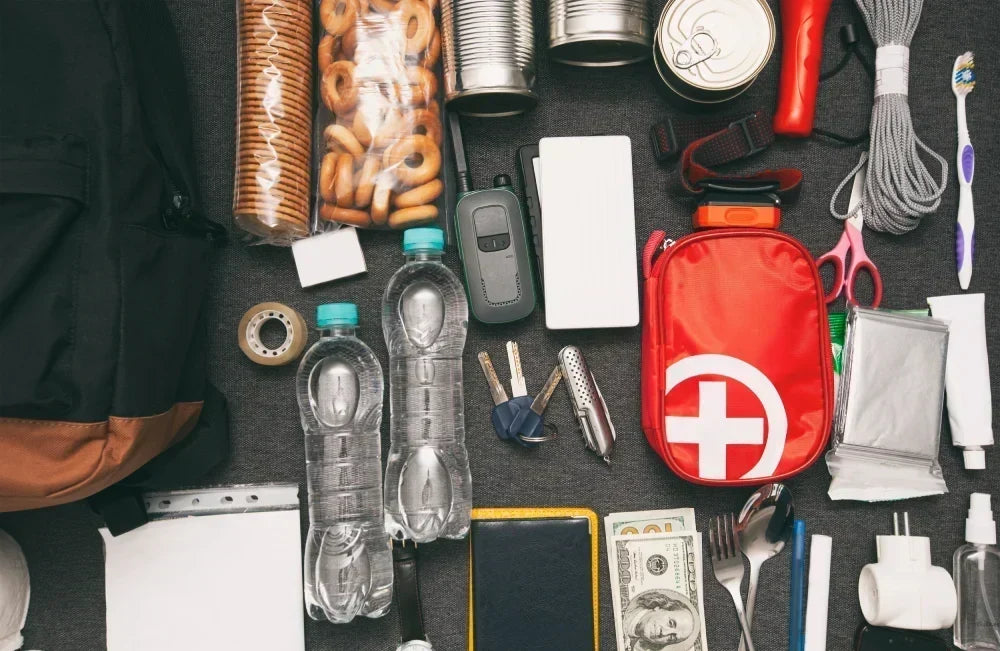
You’ll want to choose an easy-to-access location for your Essentials Kit, like a hall closet or laundry room. Your emergency kit doesn’t have to be fancy—a couple of sturdy crates would work great! Start with the following list:
- Water (1 gallon per person/pet per day—minimum of a 3-day supply)
- Nonperishable food (and a can opener if you are including canned goods)
- Plastic or paper plates, cups, and utensils
- First-aid kit
- Flashlight (We love the combos that function as flashlights, emergency radios, and electronics chargers that you can power through solar panels or hand-cranking!)
- Charged portable battery pack and cord
- Cash in a variety of denominations
- A 7-day supply of medications (both prescription and over-the-counter)
- Hand sanitizer, skin-safe wet wipes, and bleach wipes
Check out the emergency kit recommendations on Ready.gov and RedCross.org to think through other items that make sense for your home. Once you’ve pulled these items together and secured them in an accessible crate or two, you’ve done the hardest part! Everything from here on out just builds on the Essentials Kit.

2. Add What You Need to Hunker Down at Home
Many emergencies are handled by settling in at home for a few days—think blizzards, tropical storms, and extended power outages. You can save yourself stress and last-minute shopping trips if you plan ahead for what you might need (especially if the electricity goes out!).
After a giant storm or other natural event, it can be helpful to have a few things handy to help with securing your home. A couple of rolls of thick plastic sheeting (with scissors and duct tape), dust masks, work gloves, and garbage bags can all come in handy.
Think also about the comfort needs of the specific people or pets in your family. Would a deck of cards, a new coloring book, a few compact board games, extra batteries, candles and matches, or a spare leash come in handy in a lengthy power outage? Extra toilet paper? Put them in your emergency crates!

3. Build an Emergency Kit for Your Vehicles
When you are heading out on a road trip—whether across the country or across the county—you never know when you’ll be stranded on the side of the road due to traffic, weather, or car problems. Keeping a thoughtfully stocked emergency kit in each of your vehicles can save the day, especially if you’re traveling in treacherous conditions!
You can buy complete vehicle emergency kits or build your own and organize it in a sturdy backpack. Here are a few items we recommend:
- Cash in a range of denominations
- Jumper cables
- Tire pressure gauge
- Basic multipurpose tool
- Nonperishable snacks and a jug of water that can withstand freezing
- Mylar thermal blankets
- Work gloves
- An emergency beacon light
- First-aid kit
- A hand-crank flashlight/charger combo that we mentioned above
- Window breaker and seatbelt cutter
The remaining items you need to include depend on your climate! If you are traveling in Minnesota in January, you’d add an ice scraper, snow shovel, hand warmers, and waterproof hats and gloves. If you’re cruising through Nevada in the summer, you’d add extra water, sports drink powder packets, and sun protection (sunblock, wide-brimmed hats, sunglasses, and a tarp or umbrella for shade).

4. Pack a Bag to Grab and Go in an Evacuation
If you need to evacuate your home quickly for any reason, minutes count. The less time you spend wondering what to bring and wandering around looking for items, the better! Think about a backpack (or two) that you could grab quickly in case you need to relocate for a few hours or days. Store your Go Bag with your other emergency essentials and remind everyone in your home where to find it if needed.
Your Go Bag should include:
- Items from your Essentials Kit like the battery pack, first-aid kit, cash, hand-cranked flashlight/charger, and medications
- Photocopies of passports, birth certificates, deeds/leases, insurance policies, and emergency contacts — tuck them in a fireproof and waterproof pouch (less than $20 on Amazon!)
- A list of names and full contact information for your emergency contacts
- A change of clothes for every family member
- A simple toiletries kit (disposable toothbrushes, hand sanitizer, soap, deodorant, and other items that will make everyone more comfortable for a few days)
When preparing for an emergency, brainstorm what other supplies would be helpful for the folks in your group if you were displaced to a shelter for a few days (like baby formula and purified water, feminine products, or a stuffed animal).
5. Stay Informed BEEfore, During, and After an Emergency
Having the right supplies is crucial, but you also need to know what’s actually happening around you—especially in a power outage. There are so many ways to help you stay in the loop during an emergency so that you know what’s best for your family:
- Sign up for local emergency alerts through your city’s or county’s website
- Download the Red Cross Emergency app, which offers real-time weather alerts, open shelter locations, simple first-aid guidance, and more
- Talk through your evacuation and meet-up plans with your family
- Have access to a NOAA weather radio—several of the hand-cranked charger/flashlight combos we suggested above include a built-in weather radio!
- Always have a portable battery pack fully charged
None of this needs to be overwhelming! But spending a few minutes now downloading apps and thinking through how you’ll maintain access to information in an emergency will keep you from scrambling to figure out where to look when it actually matters.

6. Maintain Your Emergency Organization
Getting ready for an emergency is not a set-it-and-forget-it practice! An emergency kit with expired medication and a non-working flashlight won’t help when you need it most. Use the same calendar checkpoints your fire department suggests for testing smoke detectors—when the clocks change each spring and fall—to refresh your emergency supplies (and your memory about what’s in them!).
Swap out expired food, test batteries, review evacuation plans, make sure the apps are where you can find them on your phone, and think through anything that’s changed for your family since your last check-in. A new pet? A new medication? A new size of diaper?
Once you’ve got your emergency kit and plans in place, maintaining them truly comes down to spending just a few minutes twice a year. We promise you that it’s worth it for the peace of mind all year long!
Organizing a home emergency kit doesn’t have to happen all at once. Focus on gathering the most critical items first, and then add the others as you are able.
If the thought of choosing, sorting, and labeling emergency supplies feels overwhelming for you, you don’t have to do it alone. Our Bees are standing by to help you simplify (and safeguard) your hive! Find us near you.


