

You walk into your home and drop the stack of mail on the kitchen counter, along with an ad that a solicitor stuck in your door. Your teenager is just finishing “cleaning out their backpack,” which means a whirlwind of flyers, graded assignments, and miscellaneous scraps now rest on the dining room table. Your youngest hands you a pile of this week’s drawings and doodles from her after-school program. Your spouse is unboxing a new kitchen gadget and leaves behind the manual, the receipt, and a few brightly colored “read this first” sheets.
And just like that, you’ve got an entire mountain of paper to deal with. Again!
When we work with families and business owners across the country on organizing projects, we regularly come face to face with these avalanches of paper. It’s one of the most common sources of stress because paper represents “To Dos” that haven’t been done, there’s so much uncertainty about what to keep, and more paper enters our lives every single day … even in this so-called digital age.
Follow our steps for organizing important paperwork below to help you find your way back to a clear countertop!
Step 1: Purge and Sort
Any paperwork organization project with a hope for lasting survival must start with a Power Purge. Don’t waste your time creating storage solutions for items that you don’t need or want to keep! As we purge, we find it helpful to categorize papers into these four groups:

The Keep Forever Papers
These are the most important papers that you’ll carry with you throughout your life. Keep the physical, original versions in a waterproof and fireproof safe or a safe deposit box at the bank. Keep copies of all of these documents in a 3-ring binder with sleeves or an accordion folder for easy access.
- Birth, marriage, and death certificates
- Social security cards
- Passports (keep these accessible but secure!)
- Adoption records
- Military records
- Wills, living wills, and powers of attorney
- Property deeds
- Retirement/Pension documents
The Rotation Papers
These are the documents that you need for a season or a few years, but not for a lifetime. This includes insurance policies, retirement account quarterly statements, tax documents from previous years, receipts for major purchases, mortgage and bank information, vehicle titles, etc.
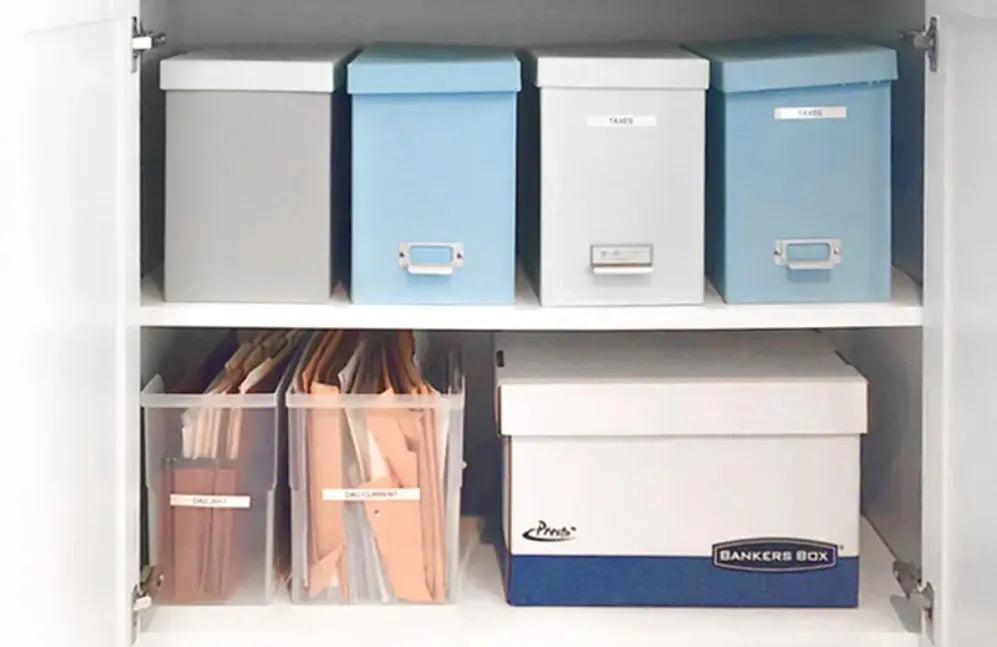
Again, an accordion file, a 3-ring binder, or a dedicated file drawer are the perfect storage spaces for these types of paper. When an updated document arrives, you can add it to the front of its section and shred the oldest version in the back. If you need a reminder on how long you need to keep various types of items, check out our handy guide!

The Precious Memories
This category includes kids’ artwork, school projects, greeting cards, photos, event programs, and other memorabilia papers that feel too emotional to toss. Find ways to display some of your absolute favorites, take photos of others and then toss, and store the rest in keepsake bins.

The Action Stack
You need to establish a single, designated spot for papers that still need attention. This is where you put the wedding RSVP, the bill you need to pay, the car registration you need to mail, the statement you need to file, and the permission slip you need to sign.
Perhaps it’s a functional tray on your office desk, a basket that you can move around with you, or a red folder or envelope that is hard to misplace. Kate Moore (Bee Organized West St. Louis) advises, “Set aside a time to handle these items weekly. Put it in the calendar!” By making the emptying of the Action Stack part of your Weekly Reset, you can prevent the paper pileup from beginning.

Step 2: Stop Paper at the Source
To truly manage your paperwork problem, you’ve got to stop it from landing on your countertops in the first place. We find in our professional document organizing work that the majority of household paper comes from just a few predictable sources.
The Mail
The USPS found in a recent study that each home receives an average of 700 pieces of mail per year, and more than half of it is junk mail! Here are our best tips for nipping it in the bud:
- Sort your mail over your recycle bin. Toss out everything you can and put the papers you must deal with in your Action Stack. Kate Roberts (Bee Organized Boston) gives her clients a Guard Your ID roller stamp that scrambles personal information. That way, you don’t need to set aside items to shred.
- Unsubscribe your address from catalog mailing lists. CatalogChoice.com is a nonprofit that helps folks unsubscribe from mailing lists. Just make a stack of the offending catalogs for a month, then spend a few minutes on the website removing yourself from their lists forever!
- Go paperless whenever you are invited to do so by banks, utilities, the DMV, medical practices, and more.
Backpacks
Kids (and adults!) bring home an astonishing number of miscellaneous papers each week in their backpacks, totebags, pockets, and laptop bags. Managing the chaos proactively will prevent those papers from stacking up and attracting more papers! We advise our clients to:
- Empty backpacks and work bags next to the recycling bin as soon as you get home. Toss anything you can before it has the chance to look around your house for a place to linger for weeks.
- Put anything that must be handled into your Action Stack.
- Encourage the person who brought the papers into the home to help create a system for where their papers should go. (Shall we hang up every day’s art on the fridge and pick our favorites to keep each week? Should we put a storage bin under your bed for graded assignments or notes from friends? Should we repurpose a cute basket for you to toss all your job, volunteer, or hobby-related papers in when you get home?)

New Purchases
Any time you buy a new item, it comes with a whole set of papers that seem too important to toss. But are they really? If something were to go wrong with your appliance or you needed to know how to replace the lightbulb, would you dig out the manual … or would you hop onto Google? For major purchases, file the receipt in your Rotation Papers and recycle the rest.
We know that paperwork is one of the most challenging categories to tackle because it requires constant diligence! If you are one of our Just-in-Casers who wants to hold on to every scrap, ask yourself how hard it would be to replace. In our digital world, bank statements, utility records, and medical receipts can be easily accessed through secure portals.
Christina Kjar (Bee Organized Northwest Austin) recommends converting as much as possible to digital: “Having an electronic filing system for paperwork eliminates the need to store the physical paper. Once you scan it and save it in a secure location, you don’t need to worry about losing it.”
Putting these systems into place (and managing what enters your home) is the only way out of the paper avalanche. And if your paper pile becomes a mountain you can’t climb, remember that you can call in the Bees! We can help you sort through the backlog and set up sustainable systems that work for everyone.


